How long does pumpkin pie last?
Start with how the pie was made and what its label says. Then use one serving clock, one refrigerator deadline, and one clearly marked freezer decision.
First, identify which pie is on the counter
“Pumpkin pie” is not one universal storage category. Traditional homemade filling contains pumpkin, eggs and milk or evaporated milk. That is a perishable custard-style food. A bakery pie sold from a refrigerated case also stays refrigerated. Some sealed commercial pies use a validated formula, process and package that allow room-temperature distribution before opening.
The safest decision does not come from the crust, a familiar brand, the ingredient list alone, or where a neighbor stores theirs. It comes from the full product history and label. Keep the outer package until the pie is finished because the storage statement, use-by date, lot code and recall identifiers may not appear on the pie pan.
| Pie in front of you | Before serving | After serving or opening |
|---|---|---|
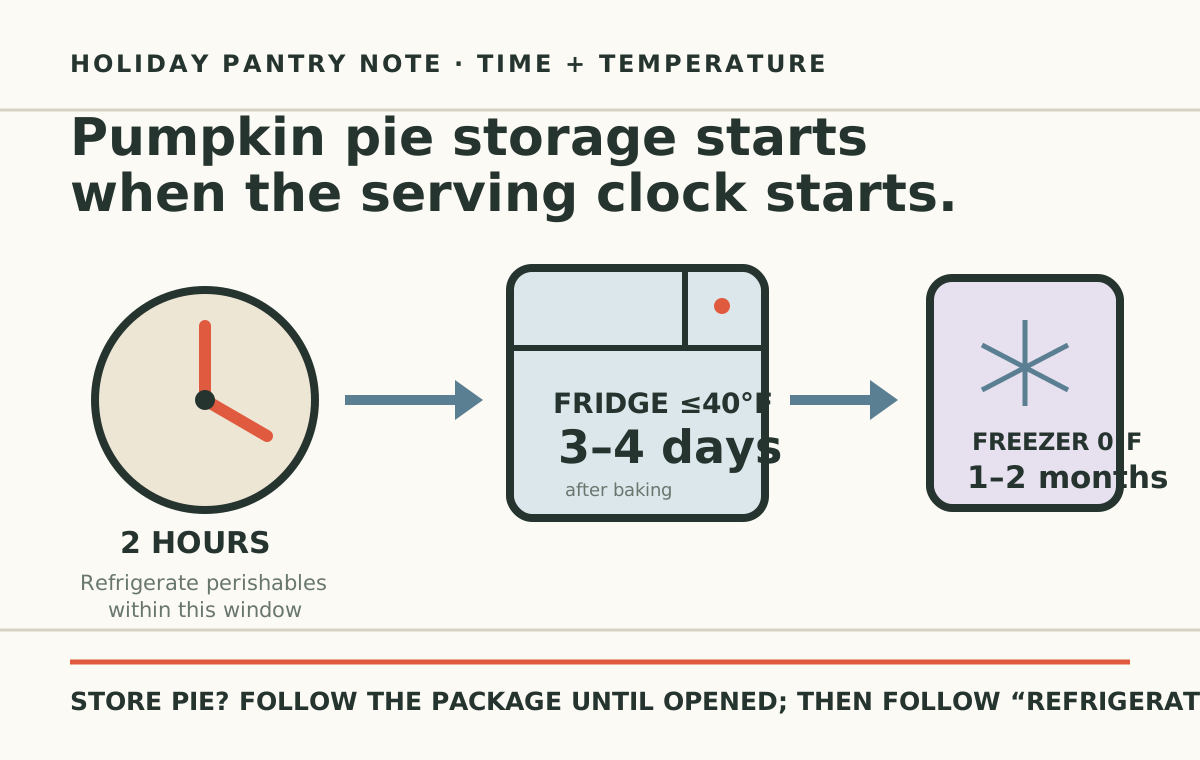
| Homemade traditional pumpkin pie | Cool and refrigerate within the two-hour limit | Refrigerate at 40°F or below; use within 3–4 days after baking |
| Store pie bought refrigerated | Keep refrigerated and follow the package | Return promptly to the refrigerator; use the label or shorter safe window |
| Sealed store pie displayed at room temperature | Follow the package storage and use-by instructions | Follow “refrigerate after opening” and any stated opened-life limit |
| Unlabeled or repackaged pie with unknown history | Do not assume it is shelf-stable | Ask the seller; if time and temperature cannot be established, discard |
The two-hour clock includes the whole room-temperature trip
FDA holiday guidance says to refrigerate food that requires refrigeration within two hours, and it explicitly includes pumpkin pie. That clock is cumulative: cooling on the counter, car travel, a buffet, dessert service and later grazing all use the same time budget. Moving the pie back to the refrigerator does not reset the clock.
If the air temperature is above 90°F, FDA's general food-storage guidance shortens the limit for perishables to one hour. That matters for a warm kitchen, outdoor meal or hot car. Do not use a porch, garage or windowsill as a refrigerator; outdoor temperature can change and does not prove the pie stayed at 40°F or below.
Set a phone timer when a perishable pie leaves refrigeration and write the time on a small card beside it. Serve slices rather than leaving the full pie out through a long meal. Put the remainder back promptly in a covered container.
Refrigerator plan: three to four days after baking
FoodSafety.gov's cold-storage chart lists pumpkin or pecan pie for three to four days after baking at 40°F or below. Count the bake day as day zero and write a use-or-freeze date rather than relying on “sometime after Thanksgiving.” A pie baked Wednesday and promptly refrigerated reaches the end of that chart window on Saturday or Sunday, depending on the exact time.
Store the pie covered to protect it from drips, handling and refrigerator odors. Put it on a stable shelf with room for cold air to circulate. The refrigerator door is not a good place for a delicate perishable because temperatures fluctuate and the pie may tip. Use an appliance thermometer; a control dial is not a temperature reading.
Do not wait for smell, taste or appearance to prove safety. FDA notes that pathogenic bacteria can make food unsafe without obvious spoilage. If the time or temperature history is uncertain, tasting a bite is not a test. Discard the pie.
Store-bought does not automatically mean shelf-stable
Some shoppers see pumpkin pies on an unrefrigerated display and conclude that every pumpkin pie belongs on the counter. FDA's technical evaluation explains the distinction: specific commercial pumpkin-pie products can be validated for room-temperature distribution through formulation, processing, packaging and stability studies. That validated process does not transfer to a homemade recipe or a different bakery product.
FDA's protocol for qualifying commercial pies calls for a use-by or sell-by date and a “refrigerate after opening” instruction. FDA's consumer-labeling guidance also warns that versions of the same food may differ in whether refrigeration is needed. Read the exact package, not a rule remembered from another pie.
Keep these five label facts
- Storage statement: “keep refrigerated” or room-temperature instructions.
- After-opening direction: especially “refrigerate after opening.”
- Use-by date: for the unopened product under stated conditions.
- Lot or production code: needed for an exact recall match.
- Opened date: write it on the package once the seal is broken.
If the store refrigerated a pie, keep it refrigerated. If a pie was sold without its original package or the label is unclear, ask the bakery or manufacturer for storage instructions. Do not infer shelf stability from preservatives in an ingredient list.
Freezer plan: portion first, then label
FoodSafety.gov lists baked pumpkin or pecan pie for one to two months in a freezer held at 0°F. That range addresses storage guidance, not a promise that the custard and crust will keep their original texture. Freezing early, while the pie is still within its refrigerated window, preserves more quality than freezing it on the final day.
- Chill the pie promptly before freezing.
- Cut serving-size portions so only what will be eaten needs thawing.
- Wrap closely, then place in a freezer container or bag that limits air exposure.
- Label the pie name, bake date and freeze date.
- Thaw covered portions in the refrigerator, not on the counter.
Do not freeze a pie to rescue unsafe room-temperature exposure. Freezing slows microbial growth; it does not reverse time already spent outside safe temperature control.
Build a pie timeline before the holiday
Work backward from dessert service. Reserve refrigerator space before baking or shopping. If refrigerator space is limited, choose a smaller pie, bake later, or freeze a finished pie according to a tested recipe and storage guidance. Do not crowd the refrigerator so tightly that cold air cannot circulate.
| Checkpoint | What to record |
|---|---|
| Baked or purchased | Date, time, source and exact storage label |
| Refrigerated | Time placed at 40°F or below |
| Served | Time removed and the remaining two-hour budget |
| Returned | Time covered pie went back to the refrigerator |
| Use or freeze | Deadline based on the bake date and label |
| Frozen | Portion count and freeze date |
Keep this timeline beside the four-day Thanksgiving leftovers plan. Both use the same habit: preserve time-and-temperature history while the kitchen is busy.
What to discard
- a homemade, refrigerated-store or opened perishable pie left out longer than two hours, or one hour above 90°F;
- a pie with unknown time or temperature history;
- a pie that required refrigeration but spent four hours or more above 40°F during a power outage, following FDA outage guidance;
- a pie with mold, damaged packaging, an unexplained broken seal or contamination from raw foods;
- a product included in a recall by exact name, size, UPC, date or lot code.
For a recall, use the exact-match recall checklist. Do not eat a recalled pie to see whether it tastes normal. Follow the recall notice for return or disposal.
Frequently asked questions
Can homemade pumpkin pie sit out overnight?
No. Traditional homemade pumpkin pie is perishable. FDA says to refrigerate pumpkin pie within two hours. If it sat out overnight, discard it.
How long is pumpkin pie good in the refrigerator?
FoodSafety.gov lists baked pumpkin or pecan pie for three to four days at 40°F or below. Count from baking, not from the first slice.
Why does the grocery-store pie sit on a shelf?
Some sealed commercial pies have a validated formula, process and package for room-temperature distribution. Follow the exact unopened storage and use-by directions, then refrigerate after opening when directed. That status does not apply to homemade pie.
Can I freeze pumpkin pie?
Yes. FoodSafety.gov lists one to two months at 0°F for baked pumpkin or pecan pie. Wrap portions well, label the freeze date and thaw in the refrigerator.
Does reheating make an overexposed pie safe?
No. Reheating is not a reliable correction for a perishable pie that exceeded its time limit. Discard it when safe handling cannot be established.
Sources
Reviewed November 3, 2026. Follow the current package label and public-health guidance for the exact product.
- FDA — Food Safety Tips for Healthy Holidays.
- FoodSafety.gov — Cold Food Storage Chart.
- FDA — Are You Storing Food Safely?.
- FDA — Evaluation and Definition of Potentially Hazardous Foods, Appendix 2 on shelf-stable commercial pumpkin pies.
- FDA — Guidance on Labeling Foods That Need Refrigeration by Consumers.
- University of Minnesota Extension — Pumpkin Spice and Everything Nice.