How long do Thanksgiving leftovers last? A four-day plan
The clock starts before the table is cleared. Use one notebook line for when food left temperature control, when it entered the refrigerator, and the day each portion must be eaten or frozen.
Holiday leftovers create two competing instincts: save the food, and leave the kitchen cleanup until later. Food safety puts a firm limit on that pause. USDA says perishable food must be refrigerated within two hours after cooking or after it leaves an appliance that keeps it hot. Food exposed to temperatures above 90°F has a one-hour limit. If a perishable dish exceeded that limit, freezing or reheating it later does not reset the clock.
The second source of confusion is the refrigerator deadline. A date label on gravy, turkey, stuffing, or mashed potatoes is not a quality guess. USDA’s general guidance is to use refrigerated leftovers within three to four days or freeze them within that period. A normal smell or appearance cannot prove a food is safe; harmful bacteria may not announce themselves.
Start the record while the meal is still happening
Write the time each perishable dish came out of the oven, refrigerator, slow cooker, warming tray, ice bath, or other temperature control. The dishes will not all share one start time. Turkey may rest while gravy remains hot on the stove and a dairy dessert stays cold in the refrigerator. Track the actual exposure rather than the time guests sat down.
| Notebook field | What to record | Why it matters |
|---|---|---|
| Dish | Turkey breast, dark meat, stuffing, gravy, casserole, potatoes, vegetables, dessert | Prevents one vague label from covering different handling histories |
| Out time | When the dish left safe hot or cold holding | Starts the room-temperature clock |
| Pack time | When portions entered refrigerator or freezer | Shows whether the two-hour rule was met |
| Container | Size, depth, portion count and lid | Supports rapid cooling and easy meal planning |
| Use by | Day four from safe refrigeration | Creates a visible decision deadline |
| Freeze by | Earlier day chosen for food that will not be eaten | Protects quality and avoids a last-minute freezer pile |
If the history is unknown—perhaps a dish sat in another room, traveled without a cooler, or was returned after guests left—do not invent a safe time. When in doubt about whether perishable food exceeded the limit, discard it. Do not taste it to decide.
Make room before the meal
A packed refrigerator cannot become an orderly cooling station by wishful thinking. Before cooking, clear expired food, consolidate safe items, wipe spills, and arrange shelves for shallow containers. Put an appliance thermometer where it can be read easily. FDA and USDA advise keeping the refrigerator at 40°F or below and the freezer at 0°F or below.
Gather clean containers in several sizes, freezer-safe packages, labels, and a marker. Match container size to likely portions. A deep stockpot of hot food cools slowly; USDA recommends dividing large quantities into shallow containers and cutting large foods into smaller portions. Turkey breast can be sliced, while legs and wings may be left whole.
Hot food can go directly into the refrigerator, according to USDA and FDA. The important step is dividing it so heat can leave quickly. An ice or cold-water bath can also help rapidly chill an appropriate container before refrigeration. Follow the container maker’s thermal limits, keep water out of the food, and never leave the batch on the counter to “cool completely.”
Use a four-day map, not a refrigerator mystery
Day 0 through day 4
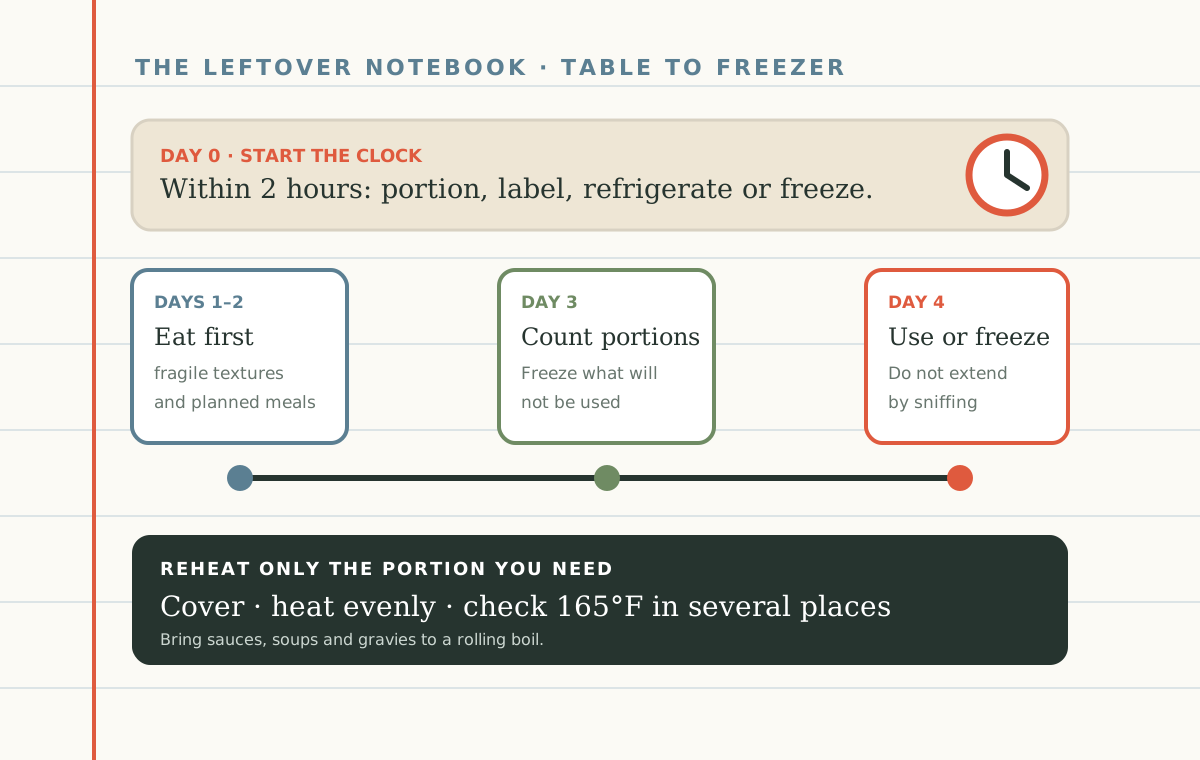
- Day 0: Refrigerate or freeze within the time limit. Label dish, packed time and day-four deadline.
- Days 1–2: Eat the portions with delicate texture or high meal priority. Keep the master containers cold.
- Day 3: Count what remains. Freeze portions that will not be used by the end of day four.
- Day 4: Eat or freeze the safely handled refrigerated leftovers. Do not extend the deadline with a sniff test.
- After day 4: Use properly frozen portions according to a written freezer plan; discard refrigerated leftovers that passed the safe window.
The day numbers are elapsed storage days, not a universal weekday. USDA often uses “the Monday after Thanksgiving” as an easy reminder when the meal happened Thursday, but your deadline depends on when the food was safely refrigerated. A Saturday gathering produces a different calendar date.
A four-day plan also reduces waste. “We will eat this sometime” is not a meal. Assign portions to breakfast, lunch, dinner, a guest take-home package, or the freezer. Keep foods separate when that gives them more flexible uses. Turkey, gravy, stuffing, and vegetables may reheat more evenly and fit more recipes when they are not compressed into one large mixed container.
Label the safety history, not just the dish name
A useful label says “turkey — packed 7:30 p.m. — use or freeze by Monday,” not merely “turkey.” For frozen food, add the freeze date and portion count. If the container moved from refrigerator to freezer on day three, record that transition.
Do not copy the original package date onto cooked leftovers as though it controls the new dish. The site’s package-date guide explains why “best if used by,” “sell by,” and most other package dates primarily address quality. Once food is cooked, served, cooled, and stored, time and temperature history drive the leftover plan.
Include allergen information when guests or household members need it. A mixed casserole may contain milk, egg, wheat, nuts, or another allergen that is not obvious later. Keep a copy of the recipe or ingredient list with the container label rather than relying on memory.
Pack shallow portions and protect the refrigerator
Use clean, covered containers or sealed storage bags suitable for the food and storage temperature. “Shallow” is about cooling distance, not a decorative shape. Spread a large batch among multiple containers instead of filling one deep bowl. Avoid overpacking the refrigerator so cold air can circulate as the appliance manual directs.
Place raw meat, poultry, and seafood below and away from ready-to-eat leftovers in sealed containers so raw juices cannot drip onto cooked food. Clean spills promptly. Keep refrigerator doors closed while a large holiday load cools.
Do not put an entire stuffed turkey into the refrigerator. USDA advises removing stuffing and refrigerating it separately in a shallow container. Break down the turkey into smaller pieces. This is also the point to decide whether bones or meat will be used for a later recipe; do not leave a picked-over carcass at room temperature while the kitchen is cleaned.
Send guests home with a clock
A take-home box inherits the meal’s time history. It does not receive a new two-hour window when it reaches a car. Label the pack time and deadline, tell the guest whether it must go directly into a refrigerator, and use a cooler with sufficient ice or frozen gel packs when the trip cannot stay within safe limits.
Pack smaller portions that can chill quickly. Avoid one warm, overfilled container holding turkey, stuffing, potatoes, and gravy in a dense stack. If a guest cannot refrigerate the food safely, choose a shelf-stable gift instead.
Freeze early enough to preserve usefulness
USDA says leftovers may be refrigerated for three to four days or frozen for three to four months for best quality; continuously frozen food remains safe indefinitely, though moisture and flavor decline over time. A quality estimate is not a reason to freeze unsafe food. Food left out too long must be discarded.
Freeze meal-sized or ingredient-sized portions. Remove excess air according to the packaging instructions, leave appropriate expansion room for liquids, and freeze packages flat when safe for the container. Label the contents, amount, packed date, freeze date, and intended use. “Gravy, 1 cup” is more actionable than “Thanksgiving.”
Some foods remain safe but change texture after freezing. Mashed potatoes, cream sauces, cooked vegetables, and baked dishes vary by recipe. Freeze a small test portion when texture matters. Food-safety guidance cannot promise quality.
Thaw without restarting the risk
USDA recognizes three safe thawing methods: refrigerator, cold water, and microwave. Refrigerator thawing is slow but keeps food cold. Cold-water thawing requires a leak-proof package, cold water changed every 30 minutes, and cooking afterward. Microwave-thawed leftovers should continue heating to 165°F.
It is also safe to reheat many frozen leftovers without thawing in a saucepan, oven, or microwave, though it takes longer. Follow the recipe, package, appliance, and container instructions. Never thaw leftovers on the counter.
If a large frozen container was thawed in the refrigerator, USDA says a needed portion may be removed and the remainder refrozen without reheating, though quality may decline. This works only when the food stayed safely refrigerated.
Reheat one meal-sized portion to 165°F
Transfer only what will be eaten. Keep the rest refrigerated. Cover food while reheating to retain moisture and help heat move through the portion. USDA advises reheating leftovers to 165°F as measured with a food thermometer. Bring sauces, soups, and gravies to a rolling boil.
Microwave ovens can create cold spots. Arrange food evenly in a microwave-safe dish, add liquid if needed, cover and vent as directed, rotate or stir, allow the recommended standing time, and check several places with a clean food thermometer. A steaming edge does not prove the center reached the target.
Dense casseroles, stuffing, thick mashed potatoes, and mixed dishes need special attention to the coolest point. Spread them to an appropriate depth and stir when the dish permits. Follow the appliance and container instructions; a takeout tub or cold-storage container is not automatically microwave safe.
What the smell test cannot tell you
Visible mold, slime, leaking, gas, an off odor, or unexpected color is reason to discard food. The absence of those signs is not proof of safety. USDA advises against tasting food to decide whether it is safe. When time, temperature, or handling history falls outside guidance, throw it away.
This matters for households with older adults, young children, pregnant people, or people with weakened immune systems, who face higher risk from foodborne illness. Follow current clinician and public-health guidance for the people eating the food.
Build the leftovers into the weekly reset
On the morning after the meal, count portions and reserve specific meals. Move the nearest-use containers to a visible refrigerator shelf. On day three, run the site’s pantry-first weekly reset: use safe leftovers as the meal anchor, choose shelf-stable additions, and freeze what will miss the deadline.
Keep the freezer inventory honest. Add the package count and location when food goes in, then remove it from the list when used. A frozen leftover has only prevented waste when the household can find it, identify it, thaw it safely, and turn it into a planned meal.
Frequently asked questions
Can Thanksgiving leftovers stay in the refrigerator for a week?
USDA’s general limit is three to four days for refrigerated leftovers stored safely at 40°F or below. Freeze portions within that window if they will be kept longer.
Does reheating make food safe if it sat out too long?
No. Food that exceeded the room-temperature limit should be discarded. Reheating is not a reset for unsafe storage.
Can leftovers go into the refrigerator while still hot?
Yes. USDA and FDA say hot food can go directly into the refrigerator. Divide large amounts into smaller portions and shallow containers so they cool quickly.
Can frozen leftovers be reheated without thawing?
USDA says many frozen leftovers can be reheated without thawing in a saucepan, oven, or microwave. Allow extra time and verify 165°F.
Sources
Reviewed October 13, 2026. Follow current public-health guidance and the instructions for the food, container, refrigerator, freezer, thermometer, and appliance.