Build a five-meal pantry buffer, not a warehouse.
A useful food buffer is a short list of complete meals your household will eat, priced at the stores you use and rotated through ordinary dinners. Five meals are enough to absorb a difficult shopping week without filling every shelf.
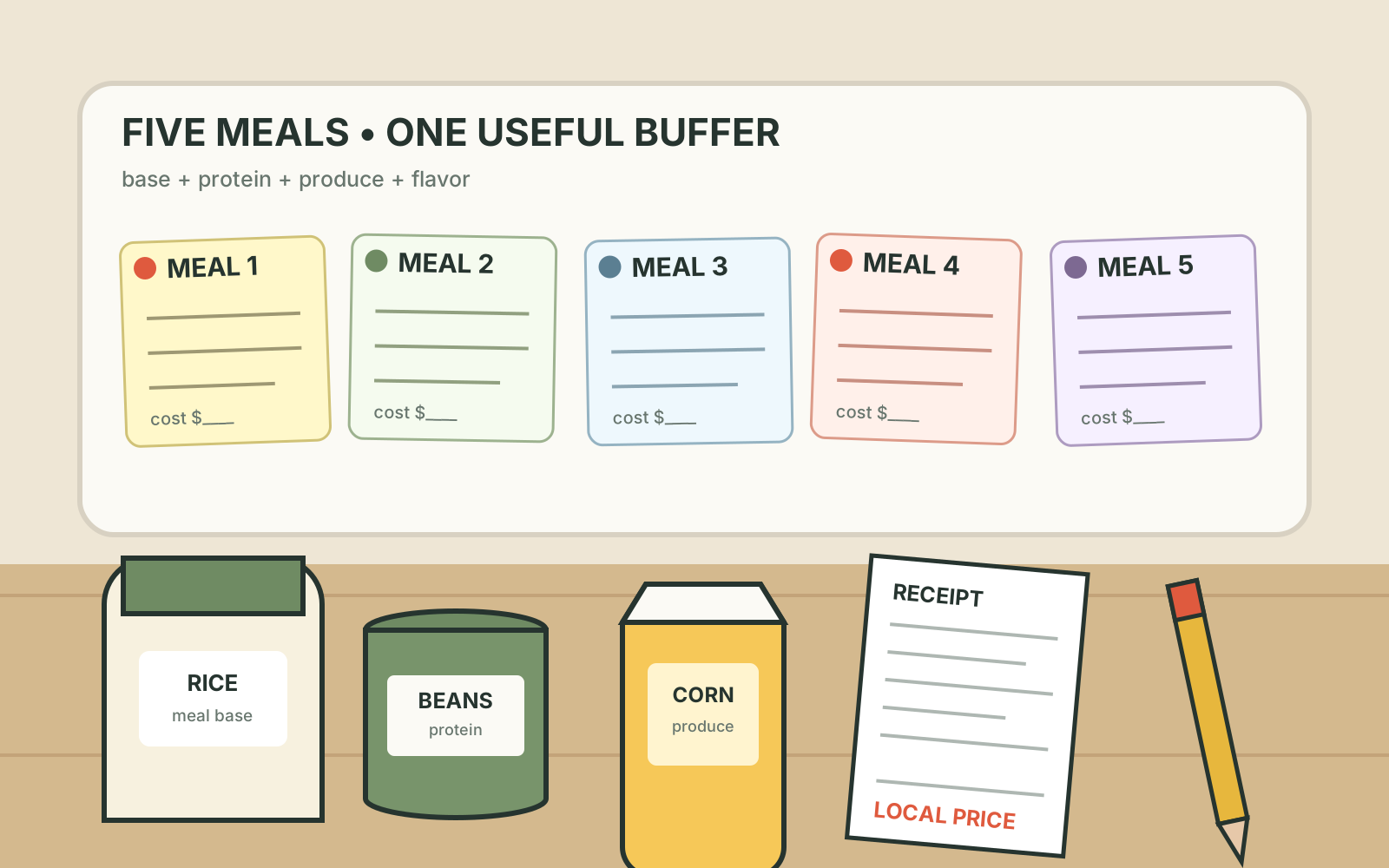
The five-meal buffer in one pass
- Write down five familiar meals that rely mostly on foods you can store.
- List the base, protein, vegetable or fruit, and flavor for each meal.
- Convert each meal into packages and realistic household servings.
- Record today’s shelf price and calculate the cost per meal.
- Keep one usable set, choose a modest reorder point, and rotate it.
Why five meals is a useful size
USDA’s September 2026 Food Price Outlook reported that grocery-store food prices in August were 2.2 percent higher than a year earlier. That national average does not describe every aisle or every household. In the same month, seven of the 15 food-at-home categories tracked by USDA rose, seven fell, and one was unchanged. Your local price for beans, tuna, tortillas, tomatoes, or a medically necessary food can move differently from the headline.
That is why this plan starts with your receipt rather than a prediction. The goal is not to beat the market. It is to keep a small set of dinners between you and an expensive, rushed, or inconvenient shopping trip. Five meals cover several days, reveal gaps quickly, and are easier to rotate than an open-ended stockpile.
A buffer also has to compete for cash and space. Twelve cans bought on sale are not savings if the household uses two, dislikes the other ten, or loses track of them. A five-meal plan gives every item a named purpose and puts a limit around buying ahead.
Step 1: choose meals your household already accepts
Begin with meals you have made more than once. Shelf-stable examples might include pasta with canned tomato and lentils, rice and beans with canned corn, tuna and peas over noodles, chickpea curry with rice, or oats with shelf-stable milk and fruit. These are examples, not a prescribed menu. Use foods that fit your culture, appetite, cooking skill, budget, allergies, medical needs, and equipment.
USDA MyPlate’s budget guidance recommends planning meals, checking foods already on hand, and using shelf-stable choices such as rice, pasta, beans, canned or frozen produce, herbs, and spices. The important word is meal. “Three pounds of rice” is inventory. “Rice, beans, corn, salsa, and the water and fuel to prepare four bowls” is a plan.
Step 2: give every meal four jobs
For each dinner, name a base, a protein or other substantial component, a vegetable or fruit, and a flavor or finishing component. The framework is intentionally flexible. A tomato-lentil pasta might use pasta as the base, lentils as the protein, canned tomatoes as the vegetable, and garlic plus dried herbs as the flavor. A household with different nutrition needs may build the plate differently.
| Meal job | Questions to answer | Common gap |
|---|---|---|
| Base | What makes this a meal: rice, pasta, tortillas, oats, potatoes, or another staple? | Owning the base but no practical way to finish it. |
| Protein or substantial component | Which beans, lentils, fish, meat, nut or seed product, dairy food, or suitable alternative belongs here? | Assuming one package serves more people than it does. |
| Vegetable or fruit | Which canned, dried, shelf-stable, frozen, or fresh item will you use? | Planning around produce that will not last until the meal is needed. |
| Flavor and finish | Does it need oil, broth, sauce, spice, salt, or a topping? | Buying staples that nobody wants to eat plain. |
Salt, oil, water, condiments, and cooking fuel are easy to treat as invisible. Count them when they matter. A jar of sauce that covers only half the pasta, or one can of beans expected to feed six adults, creates a paper meal rather than a real one.
Step 3: translate recipes into packages and servings
Write the amount actually used, the package size sold, and the servings your household gets. If a recipe uses 12 ounces of pasta but the store package holds 16, decide where the remaining four ounces will go. If a jar of sauce is opened for one meal, schedule the rest while it is still useful after opening. This is where a small buffer can reduce waste instead of creating it.
Use your household’s experience over the serving count on the front of a package. Label servings are standardized for nutrition information; they are not a promise that a package will satisfy a particular family. Record what happened after dinner: enough, short, or leftovers. Adjust the plan the next time.
For foods that require a special diet, keep the exact safe product and its full label attached to the meal. Do not assume that a cheaper flavor, brand, or size has the same ingredients or cross-contact statement. FDA requires major allergen sources to be identified on most packaged foods it regulates, but ingredients and facilities can change. Read the package each time.
Step 4: calculate the meal from today’s shelf price
Record the regular shelf price at the store you can realistically use. A simple meal cost is the sum of the portion of each package used. If a $2.40 bag of rice provides four meal-size portions for your household, assign 60 cents of rice to the meal. If a $3 jar of sauce is fully used, assign the full $3. Add the cans, seasoning, oil, or other meaningful components.
Keep both numbers: the package price tells you what cash is needed at checkout, while the meal price helps compare complete dinners. A smaller package can have a higher unit cost but still be the better choice when it prevents leftovers from being wasted or keeps the checkout total manageable.
| Meal | Packages needed | Household servings | Current cost | Replace when |
|---|---|---|---|---|
| 1 | Base + protein + produce + flavor | ___ | $___ | One set remains |
| 2 | Base + protein + produce + flavor | ___ | $___ | One set remains |
| 3 | Base + protein + produce + flavor | ___ | $___ | One set remains |
| 4 | Base + protein + produce + flavor | ___ | $___ | One set remains |
| 5 | Base + protein + produce + flavor | ___ | $___ | One set remains |
Date the price note. Compare it with the next receipt from the same store, not with a vague memory or a national average. When one component jumps, change the meal only if the replacement still fits the household. A lower price does not make an unwanted or unsafe substitution useful.
Step 5: set a par level instead of chasing sales
A par level is the amount you intend to keep on hand. Start small: one complete set for each of the five meals, or one set in use plus one backup for a meal eaten often. The reorder point might be “when only one complete meal remains” rather than “whenever this can is on sale.” That keeps the list tied to use.
Before buying an extra package, ask four questions: Does it complete a named meal? Will we use it while its quality is acceptable? Is there a cool, dry, organized place for it? Does buying it crowd out something more important this week? Four yes answers make the purchase easier to defend than a bright sale tag.
Unit prices can help compare sizes, but bigger is not automatically cheaper in practice. Check the unit shown on the shelf tag because stores may use price per ounce, pound, count, or another measure. Then account for waste and cash flow. The best package is the one that supplies the planned meal at a usable quantity.
Keep the buffer visible and safe
Group the five meals on a shelf, in labeled bins, or on a written map. You do not need to move food out of its package. Keeping the original label preserves ingredients, allergens, preparation directions, date and lot codes. Those details also matter when you need to check whether a recall includes your package.
Rotate the buffer through normal meals. During the weekly pantry reset, choose one buffer meal to eat and add only its missing components to the list. Put newer packages behind older suitable ones. Review package condition as well as the meaning of the date label; a date does not excuse a leaking, bulging, badly dented, torn, wet, pest-damaged, or otherwise compromised package.
If the buffer is meant to help during outages too, test it against the power-outage pantry plan. Count safe water, a manual can opener, and an appropriate cooking method. Never use fuel-burning equipment indoors unless its instructions explicitly allow that use.
Run a monthly five-meal audit
Once a month, make all five meals answerable on paper. Can you point to every component? Are the quantities still right? Did anyone stop eating a meal? Are prices old enough to recheck? Are any packages damaged, recalled, or close to the point when quality will decline for your intended use?
Replace meals that repeatedly fail. If the tuna pasta always leaves half a bag of noodles, change the package size or plan a second use. If a chickpea curry never gets chosen, it is not a buffer meal for this household. Move usable food into an ordinary meal before it becomes forgotten inventory, then choose a better candidate.
The finished system should look modest: five lines, five complete dinners, known costs, and a clear replacement rule. Its value comes from reducing one kind of pressure at the end of a hard week. It does not need to predict prices or occupy an entire room.
Sources and further reading
Research reviewed October 10, 2026:
- USDA Economic Research Service: Food Price Outlook, September 2026 summary
- USDA MyPlate: Healthy Eating on a Budget
- USDA MyPlate: Planning for Savings
- FDA: Food Allergies and packaged-food labeling
USDA price figures are national averages and forecasts include uncertainty. Use current local prices and the needs of your household when making a plan.