Build an allergen-aware emergency pantry from complete meals
A dependable kit is more than a shelf of “safe” products. It is a short menu built from exact packages, matched to water and tools, practiced in advance, and tied to an offline household plan.
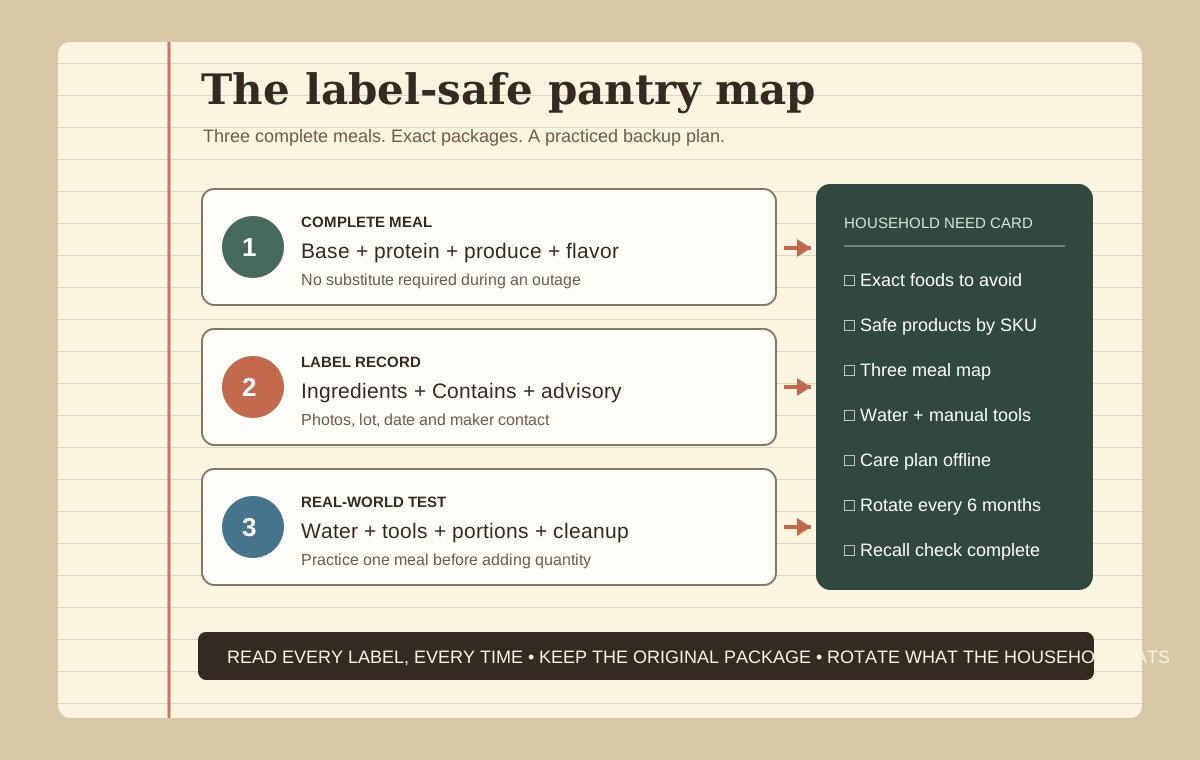
Emergency food lists often begin with categories: cereal, protein bars, canned soup, crackers, nut butter, shelf-stable milk. A category cannot answer whether a particular person can eat a particular package. Formulations change, flavors within one brand can differ, an allergen statement can be absent, and a familiar meal can fail when the power is out because it needs boiling water, refrigeration, a blender, or a clean utensil that is not in the kit.
CDC specifically includes specialty foods for people with dietary restrictions, food allergies, sensitivities, and certain medical conditions in an emergency food supply. For children with special healthcare needs, its current emergency-kit checklist calls for a three-day supply of special dietary food and supplies plus an up-to-date care plan. That is a planning floor for the checklist’s audience, not a universal prescription. Your household’s clinician-approved plan, local hazards, evacuation arrangements, and public guidance determine the actual duration and contents.
Start with the household need card
Write one clear record for each person whose food is constrained. Use the exact foods or ingredients the clinician-approved plan says to avoid, plus any texture, swallowing, metabolic, religious, sensory, infant-feeding, or medical requirements the household already follows. Do not broaden or narrow a medical restriction from an internet list.
Then record what the person reliably eats: preferred meal forms, portion pattern, safe preparation methods, independent-opening needs, sensory limits, safe utensils, and any support another caregiver needs. A technically suitable food that the person cannot open, prepare, chew, tolerate, or recognize is weak emergency inventory.
| Need-card field | Record | Why it belongs offline |
|---|---|---|
| Foods to avoid | Exact terms from the household care plan | A substitute shopper or shelter worker should not have to infer |
| Known safe meals | Exact meal plus current products and portions | A disrupted routine still has a tested starting point |
| Preparation limits | Water, heat, electricity, tools, texture, assistance | Prevents a shelf of food that cannot be served |
| Care plan | Current paper and protected offline copy | CDC recommends carrying personal care plans in emergency paperwork |
| Contacts | Caregiver, clinician, pharmacy, manufacturer where useful | Supports questions when normal services are disrupted |
Build three complete meals before buying bulk
Start with three meals the household already uses. Each meal needs a base, a protein or suitable alternative, produce or another planned component, flavor, enough safe water, and a realistic serving method. Snacks matter, but a box of tolerated snacks is not a complete meal system.
- Meal one: eat cold. Choose a complete combination that requires no heating and uses package sizes the household can finish when refrigeration is unavailable.
- Meal two: add safe water. Use a tested food whose water amount, temperature, wait time, and clean-up are recorded. Keep its water budget separate from drinking water.
- Meal three: heat if available. Choose a familiar cooked option and a fully safe fallback if the stove, microwave, power, or fuel is unavailable.
Write the actual package beside each component. “Crackers” is too broad; flavor and package size can change ingredients. “Shelf-stable milk” is too broad when the household needs a particular ingredient profile, opening method, and portion size. Treat a product as a candidate until the current package in hand passes the household’s normal label check.
Use the five-meal pantry buffer to add price and reorder points after the safety and usability map works. Do not let a bulk discount choose the menu. One small, proven package is a better test than a case that becomes unusable after a formulation change.
Read every packaged-food label in two passes
FDA identifies nine major food allergens: milk, egg, fish, Crustacean shellfish, tree nuts, peanuts, wheat, soybeans, and sesame. For most packaged foods regulated by FDA, the food source of a major allergen used as an ingredient must appear in plain language. It may appear in the ingredient name, in parentheses after an ingredient, or in a “Contains” statement.
Pass one: the ingredient list and Contains statement
Read the full ingredient list. FDA warns that not every product has a “Contains” statement. When one appears, it must name the major allergens used as ingredients, but the full list still matters for non-major allergens, other avoided ingredients, and the exact household plan. The front of the package, an old product photo, a shelf tag, and a search snippet are not substitutes.
Sesame became the ninth major allergen under federal law, with the labeling requirement effective January 1, 2023. FDA also notes that products already in commerce before that date did not have to be removed or relabeled, and some manufacturers changed recipes. Pantry food can remain stored for a long time, so the current package and its manufacturing history matter more than memory.
Pass two: advisory language and manufacturer questions
Statements such as “may contain,” “made on shared equipment,” or “produced in a facility” are voluntary. Their presence, absence, and wording cannot be translated into a universal risk ranking from this guide. Follow the household care plan. If the label does not resolve a question, contact the manufacturer or distributor listed on the package and preserve the response with the exact product, lot, and date.
FDA’s practical advice is to check a food label every time, even for a product eaten before, because ingredients can change. Make this a receiving step: nothing enters the dedicated emergency meal row until its current label is reviewed. At rotation, review the replacement package again.
Keep a package-level evidence record
Photograph all sides of every emergency-food package in good light. Capture the product name, flavor, size, ingredients, Contains statement, advisory language, nutrition and preparation directions, lot or production code, date wording, UPC, manufacturer contact, and storage after opening. The photos support recall matching and help a backup shopper identify the exact product; they do not make a later package equivalent.
| Record | Use | Do not infer |
|---|---|---|
| Brand + exact SKU | Points to one formulation and package size | That every flavor or size shares ingredients |
| Ingredient list | Supports the household’s current label review | That yesterday’s image describes today’s package |
| Contains statement | Names major allergens when the statement is used | That absence means absence of every concern |
| Advisory statement | Preserves voluntary manufacturer wording | A numeric cross-contact risk |
| Lot, date, UPC | Helps match recalls and inventory | That any one code completes the match alone |
| Manufacturer response | Documents a product-specific question at one time | A permanent promise across reformulations |
Keep original packages whenever possible. If an outer carton must be removed, keep its full label and code with the inner items. Do not mix different lots in one unmarked bin. Our food recall guide explains how to compare product, size, UPC, lot, date, distribution, and official label images.
Map water, power, tools, and clean preparation
A special-diet food that depends on a missing resource is not ready. For each meal, record water for the food, water for drinking, and water for cleaning feeding items or utensils. Follow public-health instructions whenever tap-water safety is uncertain. If a food needs hot water, identify the safe heating method and an alternative meal that does not.
Place a manual can opener in the kit if any meal needs one. Check pull tabs with the person who will use them; reduced hand strength, tremor, vision, or dexterity can make “easy open” inaccessible. Include the actual measuring cup, spoon, bowl, strainer, or safe feeding supplies the tested method requires.
Cross-contact controls need to survive disruption. A busy shared kitchen, shelter, hotel, or relative’s home may not have a dedicated counter or familiar cleaning routine. Pack clean, clearly identified utensils and a lidded preparation container when that fits the household plan. Keep the person’s food closed and separate from leaking or opened foods. Do not rely on appearance to distinguish two similar meals.
Test each meal under outage conditions
Practice during normal conditions with the electricity off for the exercise. Use only the water, tools, light, and cleanup method in the kit. Time the full process. Record whether the package opens safely, portions are adequate, instructions remain legible, the person accepts the meal, leftovers are created, and another caregiver can reproduce it.
Do not simulate unsafe water, refrigeration failure, or medication disruption. The point is to find ordinary friction without creating an emergency. Replace a meal that needs too much water, produces an unusable remainder, requires hidden power, or depends on a substitute the household has never vetted.
Separate home, evacuation, and workplace kits
CDC recommends separate emergency kits for home, work, and car for children with special healthcare needs because a family may not be home when an emergency begins. Food choices differ by location. A car sees extreme temperatures and is a poor place for products whose storage limits the manufacturer does not support. A workplace kit may need an independent utensil and a copy of the person’s plan.
An evacuation kit prioritizes portability, immediate access, clear identification, and foods that work without shared appliances. A home kit can hold more water and tools. Do not split essential items so thinly that no location has a complete meal and care record. Build one complete, tested unit first, then duplicate deliberately.
Rotate the kit without losing the evidence
CDC’s emergency checklist advises checking dates at least twice a year, reviewing needs annually, and updating the kit as needs change. Choose two calendar anchors six months apart. At each review:
- Confirm that the household care plan and contacts are current.
- Inspect package integrity and manufacturer storage conditions.
- Read every ingredient and allergen label again.
- Check official recalls using exact package identifiers.
- Move foods approaching their household rotation date into normal meals.
- Replace only after the new package passes label review.
- Practice one full meal and update water, tools, portions, and acceptance notes.
Printed dates do not replace package condition or storage history. Use our date-label guide to separate quality wording from safety decisions. Never taste food to investigate a damaged package, uncertain storage, or a recall.
Plan for refrigeration and package size
When power is out, opening a large package can create leftovers that cannot be kept safely. Choose portion sizes that match one meal or one safe use period. The power-outage meal guide explains why cold food should be protected first and why no-cook meals need their own water and tool check.
Some specialty foods, medicines, formula, or feeding supplies have temperature and handling requirements. Follow the manufacturer, clinician, pharmacist, and public-health instructions that apply. Do not move a product to a cooler, freeze it, or use it after a temperature excursion unless the responsible guidance supports that action.
Make the pantry legible to someone else
Use a simple shelf map: person or household plan, meal number, exact products, quantities, water, tools, and rotation date. Color can help navigation, but pair it with words and symbols so the system still works for color-vision differences, low light, or a black-and-white printout. Avoid labels that publicly disclose medical details beyond what the care plan requires.
Place a concise instruction card inside the kit and a protected copy with emergency paperwork. CDC recommends paper and offline electronic copies of current care plans for children with special healthcare needs. Make sure a trusted support person knows where the kit and plan are stored.
Treat every substitute as a new product
When the usual package is unavailable, do not move sideways from one flavor, size, variety, or store brand based on shelf placement. Begin the full check again. Read the ingredient list, Contains statement, advisory language, preparation and storage instructions on the substitute in hand. Confirm that it still fits the care plan, water budget, tools, portion size, and complete meal.
Write “no automatic substitute” on the offline card when that is the household rule. A well-meaning shopper should know that a similar-looking package has not been cleared. If the manufacturer cannot answer a product question, choose another already reviewed meal instead of treating uncertainty as permission.
Keep at least two complete meal patterns built from different types of products when the household plan allows it. This reduces dependence on one SKU during a recall or shortage without lowering the label standard. The backup must pass the same practice meal and receiving check as the primary choice.
Run this review inside the weekly pantry reset whenever emergency stock moves into normal meals. That keeps lot records attached, prevents a half-used kit from being forgotten, and puts replacement on the shopping list only after the current label is checked.
A seven-line inventory card
| Line | Write |
|---|---|
| 1. Person/plan | The household identifier and care-plan date |
| 2. Meal | Complete meal name and no-power fallback |
| 3. Products | Exact brand, product, flavor, size, and quantity |
| 4. Evidence | Label photo location, lot, date, UPC, maker contact |
| 5. Resources | Water, power, tools, clean preparation and serving items |
| 6. Rotation | Next six-month check and normal-use destination |
| 7. Practice | Last meal test, result, and the change made |
Begin with three complete meals. Once all three pass, extend the plan in small increments based on local guidance and the household’s actual needs. Keep variety, nutrition, cost, sodium, texture, cultural fit, and food waste visible without substituting generic advice for an individual medical plan.